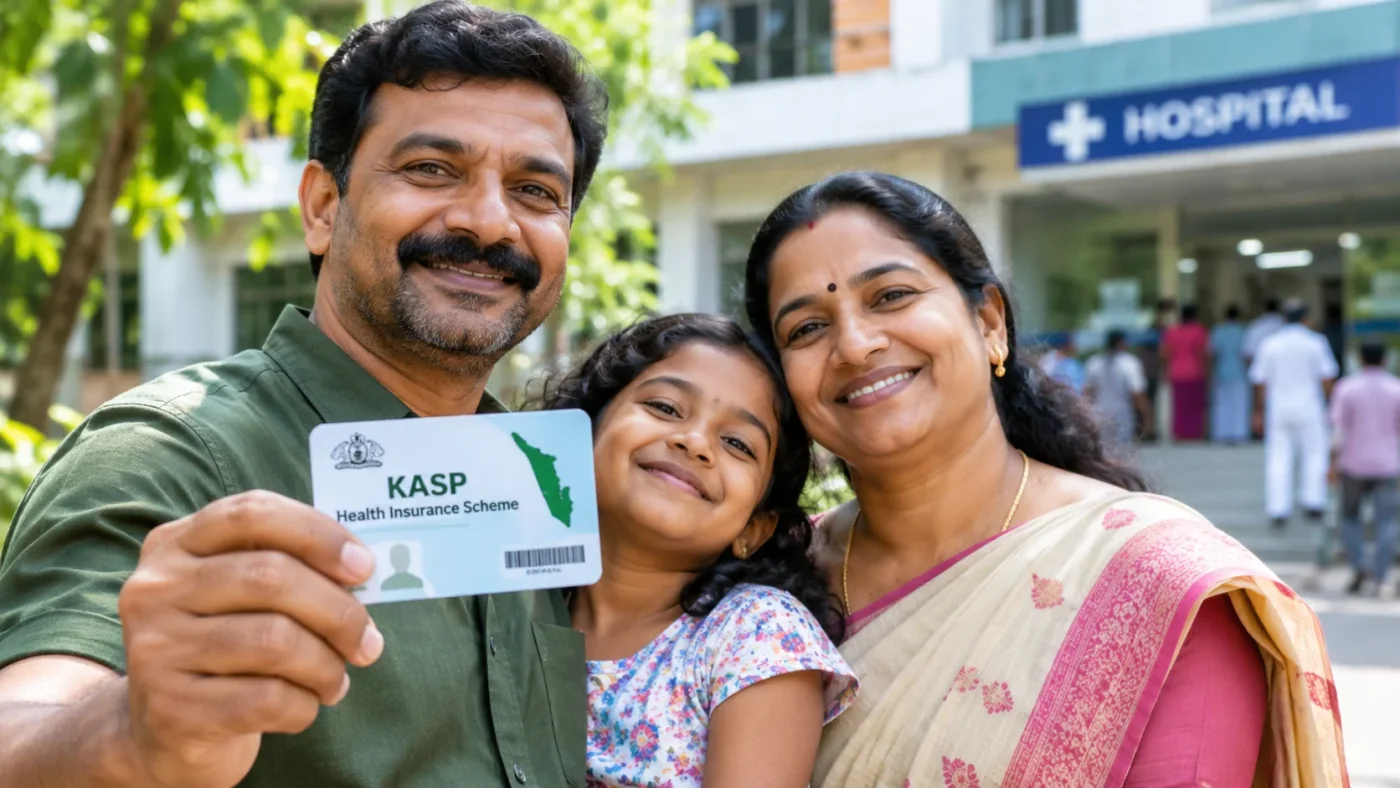
A single hospital stay can wipe out a family’s savings. Kerala’s Karunya Arogya Suraksha Padhathi (KASP) was created to prevent that for families who cannot afford major treatment. This guide explains what the scheme covers, who qualifies and how to use it when someone is admitted.
What Is KASP?
KASP is Kerala’s government-funded health protection scheme. It is the state’s version of Ayushman Bharat PM-JAY, and it is run by the Kerala State Health Agency. It is not an insurance policy you can buy. It is a welfare programme for families the government has identified as eligible.
In January 2026, revised guidelines confirmed that earlier schemes, including RSBY, CHIS, SCHIS and the Karunya Benevolent Fund, now work together with PM-JAY under the KASP framework.
The State Health Agency says the scheme targets over 42 lakh poor and vulnerable families, roughly the bottom 40% of Kerala’s population.
Key Benefits
1. Up to ₹5 lakh per family, per year. The cover is for approved secondary and tertiary hospital care, such as surgeries and longer stays, and the limit is shared across the whole family.
2. Cashless treatment. At an empanelled hospital, the hospital claims payment directly from the scheme for covered treatment, so the family does not pay the eligible cost upfront.
3. Public and private hospitals. Government and private hospitals both take part. The State Health Agency’s January 2026 fact sheet listed 591 empanelled hospitals.
4. A wide range of costs. Depending on the approved package, cover can include procedures, medicines, diagnostic tests, intensive care and implants. Each package has its own conditions.
5. No cap on family size. Under the PM-JAY component, the number of family members does not limit eligibility once the household is covered.
6. No age limit, and existing illnesses aren’t automatically excluded. The official KASP FAQ says age and pre-existing conditions are not barriers for eligible beneficiaries. The treatment itself must still fall under a covered package.
7. Very large reach. The same fact sheet reported 43,07,073 families holding at least one KASP card, and 78,83,794 cards issued.
Who Is Eligible?
Being a Kerala resident is not enough. KASP is meant for poor and vulnerable families identified under government beneficiary criteria. Check your status through the official system or at the KASP counter of an empanelled hospital before relying on the benefit.
How to Use KASP at a Hospital
- Choose an empanelled hospital that offers the treatment you need. The district-wise list is on the State Health Agency website.
- Go to the AB PM-JAY–KASP counter at the hospital.
- Carry your ID documents and your KASP or Ayushman card, if you have one.
- Ask the staff to verify your beneficiary record.
- Confirm that the planned procedure falls under an approved package and ask what the next steps are.
Do this before an emergency if you can. Knowing your status in advance saves time when it matters most.
Frequently Asked Questions
How much does KASP cover?
Up to ₹5 lakh per family per year for covered secondary and tertiary hospitalisation.
Can every Kerala resident use KASP?
No. Only families who meet the government’s eligibility criteria.
Can I use it in private hospitals?
Yes, if the hospital is empanelled.
Does age matter?
The official FAQ says there is no age restriction for eligible beneficiaries.
Does KASP cover every treatment?
No. Only treatments listed under approved packages are covered.
Conclusion
For eligible families, KASP is one of the strongest financial safety nets Kerala offers. Check your beneficiary status now, find out which empanelled hospitals are near you, and rely only on official sources such as the State Health Agency’s website.
Disclaimer: This article is for general information and is not medical or insurance advice. Scheme rules and hospital lists can change, so confirm details with the State Health Agency Kerala.