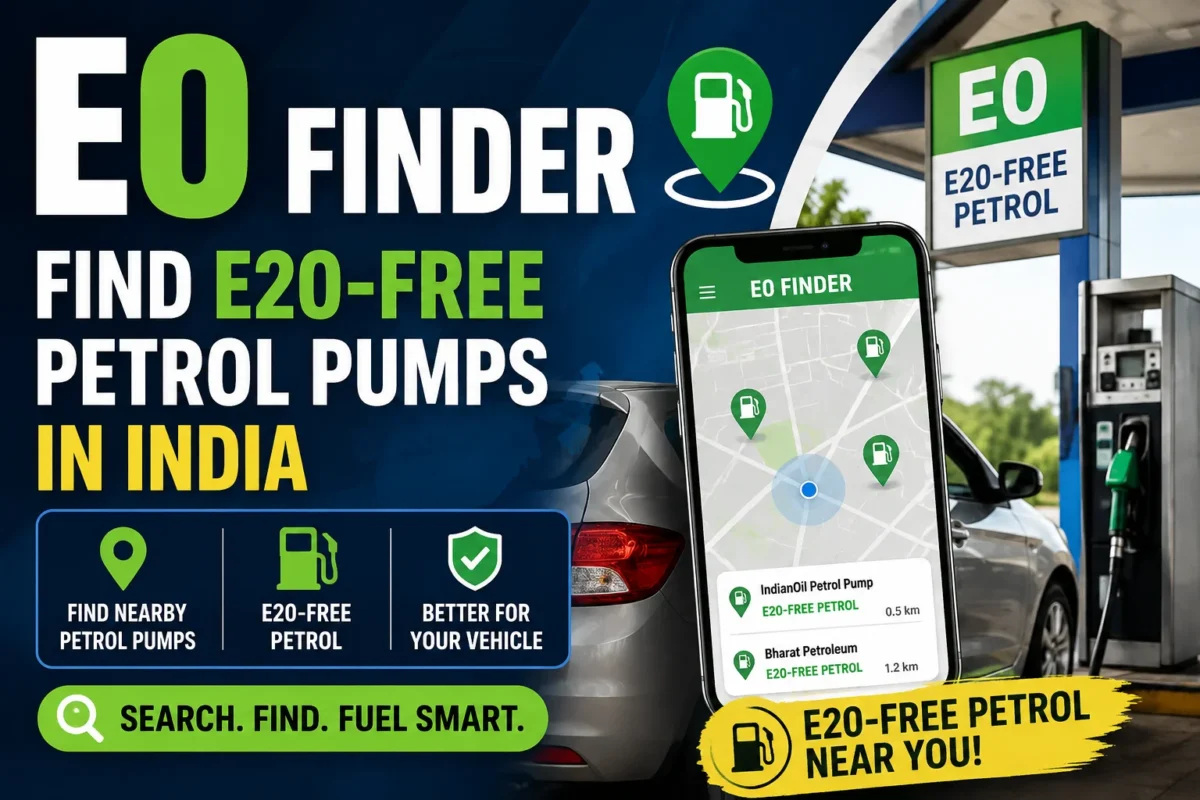
How to Find E20-Free Petrol Pumps Near You in India:- If you’ve filled up recently and noticed your older bike or car running slightly differently — a bit rough at idle, marginally lower mileage, occasional hesitation — there’s a reasonable chance ethanol blending is part of the explanation. India’s fuel ethanol programme has been moving fast, and E20 petrol — blended with up to 20% ethanol — is now the standard at many pumps across the country.
For vehicles designed with E20 in mind, this is a non-issue. For older vehicles built when E5 or E10 was the norm, the picture is more complicated. Finding a petrol pump that still sells lower-ethanol or ethanol-free fuel has become a genuine challenge — and that’s exactly the problem E0 Finder is built to solve.
This guide covers what E20 petrol actually is, why it matters for older vehicles, how E0 Finder works, and everything else you need to know before your next refuel.
Understanding India’s Ethanol Blending Programme
To understand why E0 Finder exists, it helps to understand why E20 became a thing in the first place.
India imports roughly 85% of its crude oil requirements — one of the largest import bills in the country’s budget. The National Biofuel Policy and the associated ethanol blending programme was designed to reduce this dependence by blending domestically produced ethanol (primarily from sugarcane and surplus grain) into petrol.
The progression has been deliberate:
- E5 (5% ethanol) was the early standard
- E10 (10% ethanol) became widespread
- E20 (20% ethanol) is now being rolled out nationally, with the government targeting full E20 implementation across India
From a policy perspective, the benefits are real — reduced crude imports, lower carbon emissions per litre, better market for domestic agricultural surplus. From a vehicle owner’s perspective, the implications depend entirely on what you drive and when it was made.
What Is E20 Petrol — And What’s Different About It?
E20 is petrol blended with up to 20% ethanol by volume. The remaining 80% is conventional petrol. The blend looks identical to regular petrol — same colour, same pump, often no obvious labelling difference at the station level.
The properties that differ from pure petrol:
Energy content: Ethanol has lower energy density than petrol — roughly 66% of petrol’s energy per litre. At 20% blend, this translates to a theoretical reduction in fuel economy of around 3–6% compared to pure petrol, though real-world impact varies significantly by vehicle and driving conditions.
Octane rating: Ethanol has a high octane rating, which can actually benefit engines designed to take advantage of it. E20-compatible engines are often tuned to use this higher octane, which partially offsets the energy density difference.
Water absorption: Ethanol is hygroscopic — it absorbs water from the atmosphere. In fuel systems not designed for higher ethanol blends, this can potentially cause issues over time.
Material compatibility: Higher ethanol concentrations can affect certain rubber seals, gaskets, fuel lines, and carburettor components found in older vehicles. Materials used in fuel systems designed for E5 or E10 may degrade faster when exposed to E20 over extended periods.
Starting characteristics: Ethanol has different cold-start properties than petrol. In very cold conditions, higher ethanol blends can make starting slightly harder on older engines.
Which Vehicles Are Affected?
This is the central question, and the answer isn’t always straightforward.
Vehicles generally compatible with E20:
- Cars and motorcycles manufactured from approximately 2021 onwards, where manufacturers have designed and certified engines for E20
- Many vehicles from 2015 onwards that meet Bharat Stage VI (BS6) emissions standards, though certification varies
- Vehicles where the manufacturer has explicitly stated E20 compatibility in the owner’s manual or official communications
Vehicles where caution is warranted:
- Two-wheelers and cars manufactured before 2010, particularly those with carburettors rather than fuel injection
- Vehicles with original rubber fuel lines and seals not replaced since manufacture
- Classic and vintage vehicles
- Some older fuel-injected vehicles where injectors and seals were not specified for higher ethanol blends
- Vehicles modified with aftermarket fuel system components
The honest reality: The effect of E20 on a specific older vehicle depends on the specific materials used in that vehicle’s fuel system, how well-maintained it is, local climate, and how long it’s been running on higher ethanol blends. Some older vehicles handle it without issues; others show problems over months of sustained use.
What Is E0 Finder?
E0 Finder is a location-based tool that helps vehicle owners find petrol pumps in India offering lower-ethanol or ethanol-free (E0) petrol. Instead of driving from pump to pump hoping to find one that hasn’t fully transitioned to E20, you can search your area and identify candidate stations before you travel.
The platform is particularly useful for:
- Owners of older petrol cars and motorcycles concerned about ethanol compatibility
- Classic vehicle enthusiasts who specifically require low or no ethanol fuel
- Long-distance travellers planning routes and wanting to identify fuel stops in advance
- Anyone who has noticed fuel economy or performance changes and wants to try lower-ethanol fuel for comparison
- Vehicle owners whose manufacturer has specifically recommended avoiding E20
App is available on Google Play Store and Apple App Store
How to Use E0 Finder — Step by Step
Step 1: Open E0 Finder
Access E0 Finder through your smartphone, tablet, or computer browser. No app installation is required for the web version.
Step 2: Allow Location Access
When prompted, allow the platform to access your location. This enables the tool to show petrol pumps near your current position. If you’re planning a route rather than looking for immediate options, you can also search by entering a specific city or area manually.
Step 3: Search for Available Pumps
The platform displays petrol stations in your selected area based on available information about their fuel offerings.
Step 4: Review the Results
Look for stations identified as offering E20-free or lower-ethanol fuel. The platform shows location information to help you identify the nearest suitable options.
Step 5: Verify Before You Refuel
This step is non-negotiable — fuel availability changes. A station that offered E0 last month may have switched supply since then. Before filling your tank, confirm directly with the station attendant what ethanol blend they’re currently dispensing.
E20 vs E10 vs E0 — What’s the Difference?
| Feature | E0 | E10 | E20 |
|---|---|---|---|
| Ethanol content | 0% | Up to 10% | Up to 20% |
| Energy density | Highest | Moderate | Lower |
| Theoretical fuel economy | Best | Moderate reduction | Noticeable reduction |
| Octane rating boost | None | Slight | Moderate |
| Water absorption risk | Lowest | Low | Higher |
| Older vehicle compatibility | Best | Generally good | Varies |
| Availability in India 2026 | Limited, decreasing | Moderate | Increasing, becoming standard |
| Price | May vary | Standard | Standard or marginal difference |
The trend is clear: E20 availability is growing while E0 is becoming harder to find. This is precisely why a tool like E0 Finder has practical value — as the transition accelerates, locating lower-ethanol options without a dedicated tool becomes increasingly time-consuming.
How Significant Is the Fuel Economy Impact?
This is the question most vehicle owners care about most practically, and it deserves an honest, nuanced answer.
The theoretical fuel economy reduction of E20 versus E0 is around 3–7% based on the energy density difference. In real-world driving, the actual impact depends on:
Engine tuning: Vehicles specifically calibrated for E20 can partially or fully recover the theoretical loss through optimized ignition timing and fuel mapping. For these vehicles, the real-world difference may be negligible.
Driving style and conditions: City driving versus highway, air conditioning load, traffic conditions — these factors typically have far larger effects on fuel economy than ethanol blend.
Vehicle condition: An older vehicle with worn injectors, air filter, or spark plugs will show more sensitivity to fuel changes than a well-maintained one.
Measurement accuracy: Most people estimate fuel economy based on refill frequency rather than precise measurement. The variation in how full you fill each time can easily mask a 3–5% difference.
Practical conclusion for most drivers: If your vehicle is reasonably modern and well-maintained, the E20 impact on fuel economy is likely smaller than the variation you’d see from different driving routes or conditions. If you’re noticing a significant change, the fuel isn’t the only thing worth investigating.
Also Read : Best Websites for Buying Genuine Automobile Parts in India – Complete Buyer’s Guide
What Kerala Vehicle Owners Should Know
Kerala has some specific considerations worth noting:
Climate: Kerala’s high humidity means the water-absorption property of ethanol is more relevant here than in drier states. Vehicles with older fuel systems exposed to high-humidity environments may show ethanol-related issues sooner.
Older two-wheeler prevalence: Kerala has a significant population of older motorcycles and scooters — vehicles from the 2000s and early 2010s are common. Many of these have carburettors and rubber fuel system components from an era when E5 was the standard.
Classic and vintage vehicle community: Kerala has an active classic vehicle community. For these owners, E0 petrol is often not just preferable but necessary for proper operation and preservation.
Long-distance travel: Kerala’s geography means many residents travel regularly through the state and into Tamil Nadu, Karnataka, and beyond. Having access to a pump finder tool for route planning is genuinely useful.
How to Check If Your Vehicle Is E20 Compatible
Before making any fuel decisions, check these sources in order:
1. Owner’s Manual
The most authoritative source. Look for the fuel specification section — it will state the recommended octane rating and any ethanol blend limitations. If it says “suitable for up to E10” or specifies a maximum ethanol percentage, that’s your guide.
2. Manufacturer’s Website or Service Bulletin
Many manufacturers have issued E20 compatibility lists as the blending programme has expanded. Check the official website for your vehicle brand and model.
3. Authorised Service Centre
If you can’t find clear information in the manual or online, your brand’s authorised service centre can give a definitive answer for your specific model and year.
4. Fuel Cap or Fuel Door Sticker
Some newer vehicles have E20-compatible stickers near the fuel cap. Absence of this sticker doesn’t mean incompatible — it may just mean the vehicle predates labelling requirements.
What to avoid: Online forums and word of mouth for compatibility decisions. Anecdotal reports of “my bike runs fine on E20” from someone with a different model year in a different climate don’t tell you much about your specific vehicle.
Signs Your Older Vehicle May Be Struggling With Ethanol Blends
If you’re already running E20 in an older vehicle and wondering whether it’s causing issues, watch for:
- Noticeable drop in fuel economy beyond what weather and traffic explain
- Rough idling or hesitation at low speeds
- Harder starting, particularly in the morning or after the vehicle has sat for a few days
- Fuel smell stronger than usual (can indicate ethanol affecting seals)
- Fuel system components showing unusual wear or degradation at service
- Carburettor issues in older bikes — gumming, jets partially blocked
None of these definitively prove ethanol is the cause, but they’re worth noting and raising with your mechanic if you switch back to lower-ethanol fuel and the issues resolve.
Practical Tips for Owners of Older Vehicles
Switch gradually if you’re going from E20 back to E0. Don’t drain the tank — just refuel with lower-ethanol petrol when the tank is low. Most vehicles handle the transition without issues, but a gradual switch is better than a sudden complete change.
Use ethanol-compatible fuel additives if lower-ethanol fuel isn’t accessible. Some additives claim to protect fuel system components from ethanol-related degradation. Whether these work as claimed varies by product — consult your mechanic before using them.
Service your fuel system more frequently if you’re running E20 in an older vehicle. Fuel filters, carburettor cleaning (for older bikes), and fuel line inspection become more important.
Keep a record of fuel economy. Fill up completely, reset your trip meter, and calculate economy at the next fill. Doing this consistently lets you detect changes that might correlate with fuel blend differences.
Plan long trips around fuel availability. If you need E0 for your vehicle, use E0 Finder to identify stations along your route before departure — not after you’ve passed the last suitable pump.
Frequently Asked Questions
Will E20 damage my older vehicle immediately?
Probably not immediately — the effects of higher ethanol blends on older fuel systems typically accumulate over months and years rather than showing up after one or two tank fills. However, this depends heavily on your vehicle’s specific components and condition.
Is E20 actually mandatory to buy? Can I ask for E0?
You can ask — and if the station carries E0, you can buy it. There’s no law requiring you to buy a specific ethanol blend. The challenge is availability, which is what E0 Finder addresses.
Does E20 affect diesel vehicles?
No. Ethanol blending in India’s current programme applies to petrol (gasoline). Diesel vehicles are unaffected by the E20 transition.
My bike ran fine on E10 for years — will E20 be a problem?
Possibly, possibly not. E10 to E20 is a doubling of ethanol content, which can cross material compatibility thresholds for some older fuel system components. Monitor performance and fuel economy after the transition.
How do I know what ethanol blend a petrol pump is dispensing?
This is genuinely difficult — pumps aren’t always clearly labelled with ethanol content. The most reliable approach is to ask the station manager directly. E0 Finder helps identify stations more likely to carry lower-ethanol options, but verification at the pump is always necessary.
Can I mix E0 and E20 in the same tank?
Yes. Mixing different ethanol blends in the same tank is fine — the result is an intermediate blend. If you fill half a tank of E0 into a half-tank of E20, you get roughly E10.
Does higher ethanol mean lower quality petrol?
Not necessarily — ethanol’s high octane rating is a genuine quality advantage for engines designed to use it. The “quality” question for ethanol is really about compatibility with your specific vehicle, not about petrol quality in a general sense.
Are there states in India where E20 is more or less prevalent?
Yes. E20 rollout has been faster in some states than others, depending on ethanol supply availability and state government implementation pace. In 2026, availability varies by region — which is another reason a tool like E0 Finder has practical value.
The Bigger Picture — India’s Fuel Transition
E20 is not the end of India’s ethanol journey. The government’s biofuel policy envisions exploring even higher blends for flex-fuel vehicles — E85 and E100 — as the automotive fleet transitions toward vehicles designed for these fuels.
This means the availability of lower-ethanol petrol will likely continue to decrease over the coming years. For owners of older vehicles, this creates a narrowing window — both in terms of how long lower-ethanol fuel remains easily available, and in terms of how long maintaining older vehicles on appropriate fuel remains practical.
For many older vehicle owners, the pragmatic long-term response is either:
- Ensuring fuel system components are upgraded to ethanol-compatible materials (possible for many vehicles, though cost varies)
- Transitioning to a newer vehicle designed for E20 or higher blends
- Using E0 Finder and similar tools to maximize access to lower-ethanol options for as long as they remain available
Bottom Line
India’s shift to E20 petrol is happening faster than many vehicle owners realize, and it’s creating a genuine practical challenge for the millions of older cars and motorcycles on the road that weren’t designed with higher ethanol blends in mind.
E0 Finder addresses the immediate practical problem — finding a petrol pump that still carries lower-ethanol fuel — in the simplest possible way: location-based search that shows you what’s near you. It won’t solve the long-term availability question as India’s ethanol programme advances, but for now it’s a useful tool for owners who need it.
Use it alongside verification at the pump, your vehicle manufacturer’s official guidance on fuel compatibility, and your own observations about how your vehicle is performing on current fuel.
If you’re unsure whether E20 is affecting your vehicle, the best starting point is your owner’s manual and your authorised service centre — not online forums. And if you need to find lower-ethanol petrol near you, E0 Finder is currently the most practical way to do it.