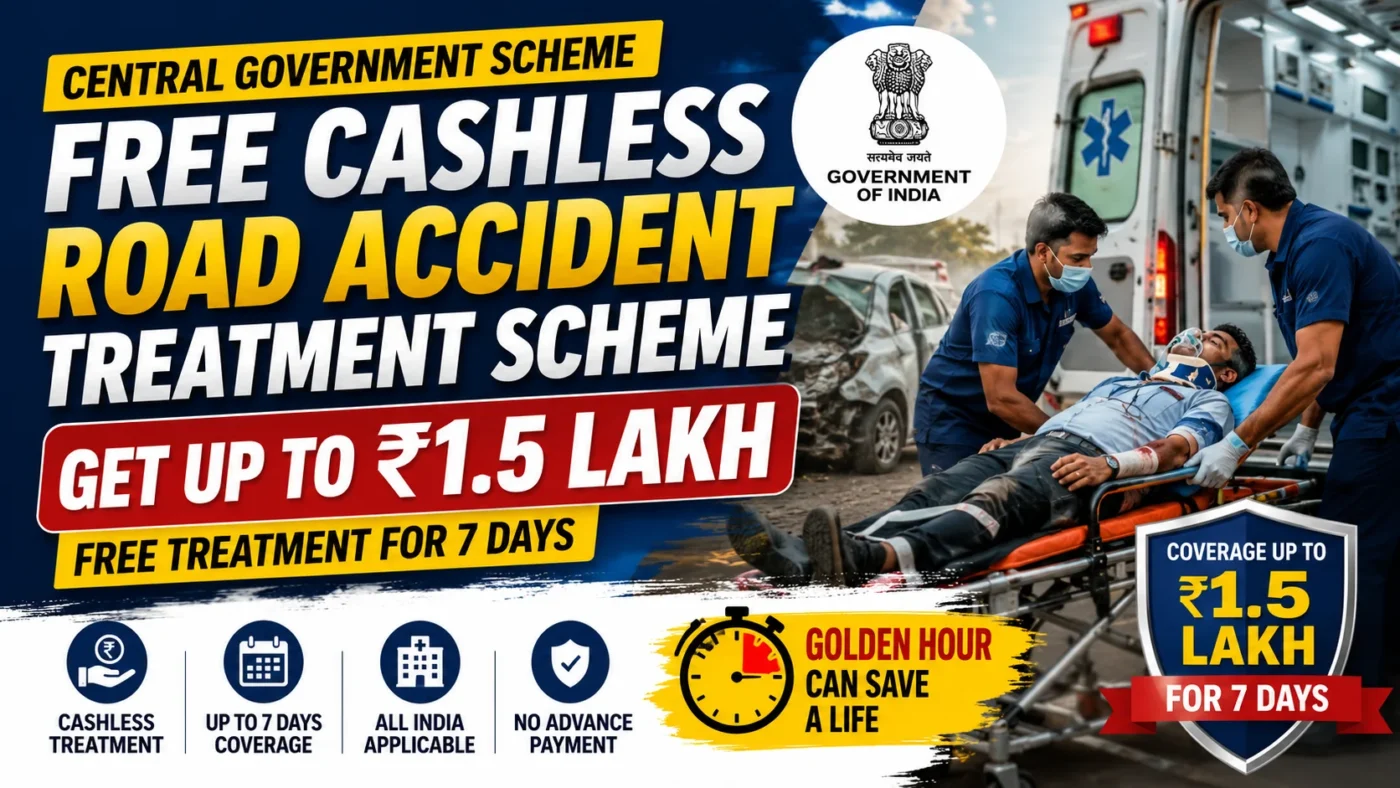
Free Cashless Road Accident Treatment Scheme:- Every year in India, people die from road accident injuries not because treatment wasn’t available — but because no one at the hospital could confirm who would pay for it. The injured person is lying in the emergency ward, family members are scrambling to arrange cash or find a guarantor, and precious minutes are slipping away. The medical staff are ready. The money isn’t.
This is the problem the Cashless Treatment of Road Accident Victims Scheme — officially known as PM RAHAT (Road Accident Victim Hospitalization and Assured Treatment) — is designed to eliminate. Under this central government initiative, any eligible road accident victim can receive up to ₹1.5 lakh in cashless emergency medical treatment for up to 7 days, without making any upfront payment at empanelled hospitals.
No insurance card required. No deposit. No guarantor. Just immediate treatment.
Here’s everything you need to know about how the scheme works, who it covers, and what to do if you or someone you know is involved in a road accident.
Why This Scheme Exists — The Problem It’s Solving
India records over 4 lakh road accidents every year, resulting in approximately 1.5 lakh deaths. A significant proportion of those deaths are preventable — not because the injuries were unsurvivable, but because treatment was delayed while financial arrangements were being sorted out.
Emergency medicine has a concept called the Golden Hour — the first 60 minutes after a traumatic injury when immediate medical intervention has the highest chance of preventing death or permanent disability. Every minute spent arranging funds rather than providing treatment reduces the chance of survival.
The PM RAHAT scheme addresses this directly. By making treatment cashless and immediate at the point of admission, it removes the financial barrier that has historically turned the Golden Hour into a bureaucratic delay.
The scheme was launched by the Ministry of Road Transport and Highways (MoRTH) under the provisions of the Motor Vehicles Act, and operates through a network of empanelled government and private hospitals across India.
What the Scheme Covers
Financial Coverage
- Maximum cashless treatment: ₹1,50,000 per accident victim
- Treatment period: Up to 7 days from the date of the accident
- Coverage stops when either limit — the ₹1.5 lakh amount or the 7-day period — is reached first
Medical Services Covered
The scheme pays for emergency medical treatment including:
- Emergency consultation and triage
- Trauma care
- Surgeries (emergency)
- ICU admission and treatment
- Medicines required during the covered period
- Diagnostic tests — X-rays, CT scans, blood work, and other emergency diagnostics
- Hospital admission charges
- Other approved emergency medical services
The coverage is specifically designed for acute emergency care — the treatment required immediately after the accident to stabilize the patient and address life-threatening injuries. It is not intended as ongoing post-acute care beyond the 7-day window.
Who Is Eligible?
The scheme is broad by design — the intention is to cover as many accident victims as possible without complex eligibility filters that would slow down emergency admission.
You can receive benefits under this scheme if:
- You are injured in a road accident involving a motor vehicle
- You are admitted to a hospital within the prescribed time after the accident
- The accident is reported as per scheme guidelines (police involvement is part of the process)
- Treatment is received at an empanelled hospital or transferred according to scheme procedures
Notably:
- No health insurance is required — the scheme is separate from and independent of private health insurance
- No income limit — the scheme doesn’t restrict benefits based on the victim’s financial status
- Applicable on all road categories — national highways, state highways, urban roads, rural roads — anywhere a motor vehicle accident occurs in India
The one key condition: the accident must involve a motor vehicle. Accidents not involving motor vehicles fall outside the scheme’s scope.
What Happens Step by Step After an Accident
Understanding the process matters — especially for bystanders and family members who may be the first to respond.
Immediate Response: The First Few Minutes
Step 1: Call emergency services
Dial 112 — India’s national emergency number. This connects you to police, ambulance, and fire services. In Kerala, you can also use 108 for ambulance services. Don’t assume someone else has called — make the call yourself.
Step 2: Get the victim to the nearest hospital
In a life-threatening emergency, the nearest hospital — not necessarily an empanelled one — is the right first destination. Stabilization treatment can be provided at any hospital during an emergency. Transfer to an empanelled facility can happen after the patient is stable, according to the scheme’s operational guidelines.
The critical point: do not delay getting medical help while trying to find an empanelled hospital. Save the life first. The scheme’s paperwork can follow.
Step 3: Inform the police
The accident must be reported to the police as part of the scheme’s process. In most cases, calling 112 handles this simultaneously. The police involvement creates the official record that activates the scheme’s coverage.
At the Hospital
Step 4: Hospital verifies eligibility
The empanelled hospital checks eligibility under the scheme based on the accident details and police report. This process is designed to happen quickly — the scheme’s purpose is to remove delays, not create new ones.
Step 5: Treatment begins without payment demand
Once eligibility is confirmed, treatment begins immediately. The hospital cannot demand advance payment or a financial guarantee from the victim or family during the covered period.
Step 6: Hospital submits reimbursement claim
After treatment, the hospital submits its reimbursement claim to the government through the designated system. The financial transaction is between the hospital and the government — the patient is not involved in this process.
The Golden Hour — Why Speed Matters More Than Anything Else
The scheme’s emphasis on the Golden Hour isn’t just a medical concept — it’s the entire rationale for why cashless treatment matters.
Research in trauma medicine consistently shows that survival rates for serious injuries — head trauma, internal bleeding, spinal injuries — drop significantly with each passing hour without treatment. The difference between treatment at 30 minutes and treatment at 3 hours can be the difference between full recovery, permanent disability, or death.
The most common reason for delay in India’s emergency rooms historically hasn’t been lack of medical capacity — it’s been financial authorization. A patient arrives, the family doesn’t have cash, the hospital wants a deposit, someone is making phone calls to relatives, and the clock is running.
PM RAHAT is built to eliminate exactly that delay. By pre-authorizing cashless treatment up to ₹1.5 lakh, it allows medical staff to begin treatment immediately while the financial process runs separately.
What To Do as a Bystander
If you witness a road accident or arrive at the scene:
Call 112 immediately. Don’t assume it’s already been done.
Help get the victim to medical care. Good Samaritan laws in India protect bystanders who assist accident victims in good faith — you cannot be held legally liable for helping. The Supreme Court of India has specifically directed that hospitals cannot detain or harass Good Samaritans who bring accident victims for treatment.
Tell the hospital about the scheme. When you arrive at the hospital, mention that the victim is entitled to cashless treatment under the PM RAHAT / Cashless Road Accident Treatment scheme. Emergency staff at empanelled hospitals should be aware of it, but a direct mention ensures it’s on the table immediately.
Don’t leave without giving a statement if police ask. A police record of the accident is what activates the scheme. Bystander statements help establish the facts quickly.
Key Facts at a Glance
| Detail | Information |
|---|---|
| Scheme Name | PM RAHAT / Cashless Treatment of Road Accident Victims |
| Launched By | Ministry of Road Transport & Highways (MoRTH) |
| Maximum Coverage | ₹1,50,000 per victim |
| Treatment Period | Up to 7 days from accident date |
| Roads Covered | All road categories across India |
| Insurance Required | No |
| Upfront Payment | Not required during covered period |
| Emergency Number | 112 |
Important Limitations to Understand
Being clear about what the scheme doesn’t cover is as important as knowing what it does:
It covers emergency treatment, not long-term care. The 7-day window is for acute emergency stabilization. Treatment beyond 7 days or beyond ₹1.5 lakh requires other funding — personal resources, insurance, or state-specific schemes.
It applies to motor vehicle accidents. Falls, bicycle accidents, and other non-motor vehicle incidents are not covered.
It works through empanelled hospitals. While stabilization can happen at any nearest hospital, the full cashless benefit operates through the network of hospitals empanelled under the scheme. In practice, most major government hospitals and many private hospitals in urban areas are empanelled — but it’s worth knowing this distinction.
Police reporting is part of the process. This is a government scheme with a formal process, not an informal arrangement. The accident needs to be officially reported for the claim to be processed.
Hospital List
| District | Hospital |
|---|---|
| Thiruvananthapuram | General Hospital Thiruvananthapuram |
| Thiruvananthapuram | Govt. Medical College Hospital, Thiruvananthapuram |
| Ernakulam | Ernakulam General Hospital |
| Ernakulam | Lourdes Hospital |
| Ernakulam | Amrita Hospital, Kochi |
| Ernakulam | Medical Trust Hospital |
| Ernakulam | M.A.J. Hospital |
| Ernakulam | District Hospital Aluva |
| Kottayam | Govt Medical College Hospital Kottayam |
| Kozhikode | Govt. Medical College Hospital, Kozhikode |
| Kozhikode | Baby Memorial Hospital |
| Malappuram | Ascent ENT Hospital, Perinthalmanna |
| Thrissur | Govt General Hospital Irinjalakuda |
| Thrissur | Rohini Hospital |
| Thrissur | Daya General Hospital & Specialty Surgical Centre |
| Pathanamthitta | Thiruvalla Medical Mission Hospital |
| Alappuzha | Sahrudaya Hospital |
| Wayanad | Government General Hospital Kalpetta |
“Cashless treatment is available at eligible Government hospitals and State Health Agency (KASP/PM-JAY) empanelled private hospitals across Kerala. Patients or their relatives should confirm eligibility with the hospital or the State Health Agency at the time of admission.”
How This Connects to Kerala
Kerala has one of the highest rates of road accident fatalities per registered vehicle in India — a reflection of road conditions, traffic density, and driving patterns across the state. The NH 66 coastal highway, mountain roads in Wayanad and Idukki, and urban congestion in Thiruvananthapuram, Kochi, and Kozhikode all contribute to accident frequency.
For Kerala residents, the PM RAHAT scheme operates through empanelled hospitals across the state — government medical colleges, district hospitals, and empanelled private hospitals. If you’re involved in or witness an accident anywhere in Kerala, calling 112 connects you to the Kerala Police and ambulance services, and the scheme’s coverage applies regardless of which district you’re in.
The practical reality for Kerala families: knowing this scheme exists before you need it is far better than discovering it after. Share this information with family members, especially those who drive long distances regularly or work in transportation.
Frequently Asked Questions
Is the treatment really completely free? What about costs beyond ₹1.5 lakh?
Within the scheme’s limits — ₹1.5 lakh and 7 days — yes, completely cashless. Costs beyond those limits are not covered by the scheme and would need to be handled through other means — insurance, personal funds, or state-level schemes.
Does the victim need to have any documents at the hospital?
In an emergency, the immediate priority is treatment — not paperwork. The scheme is designed so that treatment begins without requiring documents upfront. Identity and accident verification happens as part of the process, but shouldn’t delay initial emergency care.
What if the nearest hospital isn’t empanelled?
Go to the nearest hospital regardless. Stabilization treatment can be provided, and transfer to an empanelled facility can happen once the patient is stable. Don’t bypass the nearest hospital in a life-threatening emergency to find an empanelled one.
Can a hit-and-run victim use this scheme?
Yes. Hit-and-run victims are specifically covered under provisions of the Motor Vehicles Act, and the PM RAHAT scheme applies. The absence of an identified vehicle or driver doesn’t disqualify the victim from receiving cashless treatment.
What if the family wants to take the patient to a private hospital of their choice?
The scheme operates through empanelled hospitals. If the family chooses a non-empanelled private hospital, the cashless treatment benefit may not apply — costs would need to be handled directly and potentially reimbursed through other schemes if applicable.
Is this scheme available 24/7?
Yes. Road accidents don’t follow business hours, and the scheme is meant to operate round the clock at empanelled hospitals.
Does having motor insurance affect eligibility?
No. The PM RAHAT scheme is separate from motor insurance. Having or not having vehicle insurance doesn’t affect a victim’s eligibility for cashless treatment under this scheme.
What happens after the 7 days are over?
The cashless coverage under PM RAHAT ends after 7 days or ₹1.5 lakh, whichever comes first. Subsequent treatment costs would typically be covered by the vehicle owner’s insurance, a court-ordered Motor Accident Claims Tribunal (MACT) settlement, personal health insurance, or personal funds.
What Every Driver and Family Should Know
Road accidents are one of those emergencies that people consistently feel won’t happen to them — right up until they do. The practical advice here is simple:
Save 112 in your phone. It’s India’s national emergency number covering police, ambulance, and fire. Every adult in your family should have it.
Know that cashless treatment exists. If you’re ever in an accident or at the scene of one, knowing about this scheme means you can tell the hospital immediately rather than letting financial discussions delay treatment.
Don’t let money be the reason someone doesn’t get treated. The scheme exists precisely to prevent this. If a hospital at the emergency stage is demanding upfront payment from an accident victim, mention the PM RAHAT scheme explicitly and escalate if needed.
Share this information. The scheme’s effectiveness depends on people knowing it exists. Truck drivers, auto drivers, delivery executives, and frequent highway travelers in Kerala — the people most at risk — are often the least likely to have encountered this information.
Bottom Line
The PM RAHAT Cashless Road Accident Treatment Scheme is one of the more important public health initiatives the central government has put in place in recent years. It addresses a specific, documented, preventable problem — deaths caused not by unsurvivable injuries but by financial delays at the point of emergency treatment.
Up to ₹1.5 lakh, up to 7 days, no upfront payment, no insurance required. That’s the scheme in a sentence.
The best thing you can do with this information is remember it before you need it — and share it with the people around you so they have it too.
For emergencies anywhere in India: Call 112.
Stay connected with SpotNews Kerala for more guides on government schemes, road safety, health initiatives, welfare programmes, and public services.