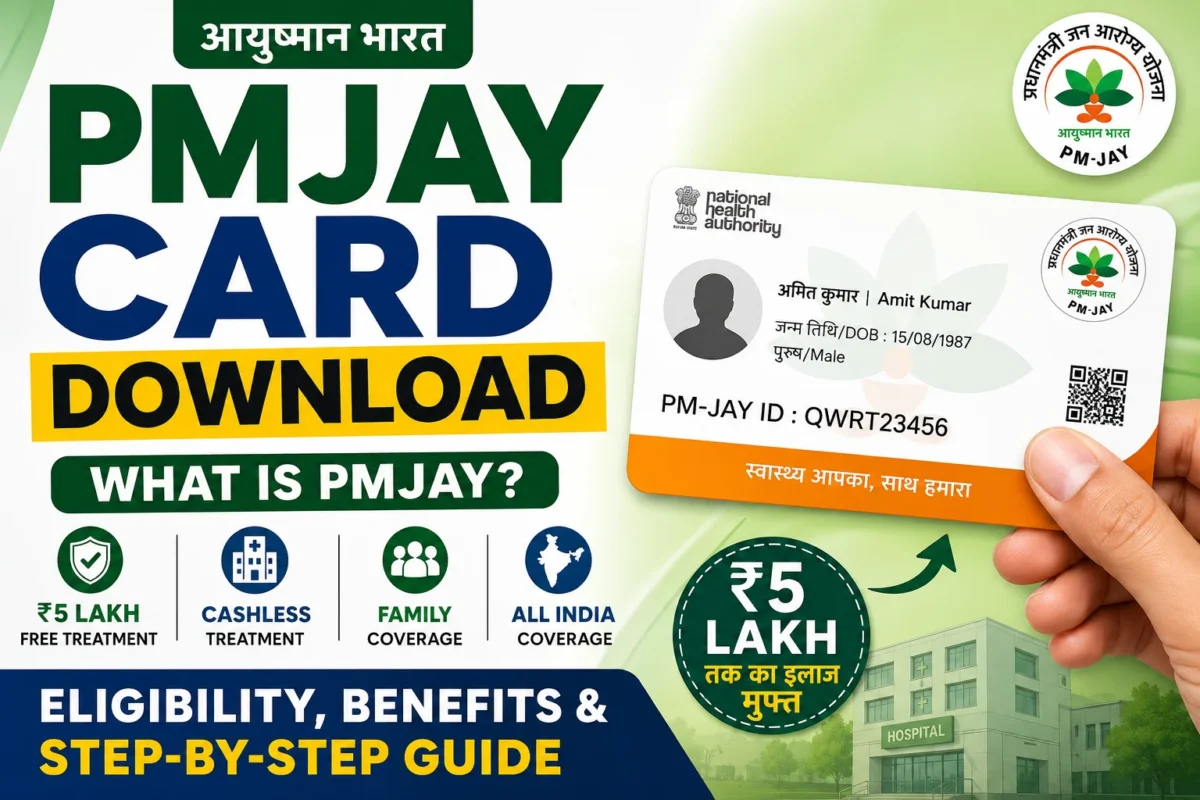
PMJAY Ayushman Card :- A single serious illness can financially destroy a family that spent decades building a stable life. One hospitalization — a heart surgery, a cancer diagnosis, a kidney failure requiring dialysis — and the savings are gone, the house is mortgaged, and the debt follows for years afterward. This isn’t a rare scenario in India. It’s how medical expenses work for the majority of families who don’t have employer-provided health insurance or the income to afford private coverage.
The Ayushman Bharat Pradhan Mantri Jan Arogya Yojana — PMJAY — is the central government’s attempt to change that equation for economically vulnerable families. It’s one of the largest government-funded health insurance schemes in the world, covering eligible families for up to ₹5 lakh in cashless hospitalization every year at empanelled government and private hospitals across India.
If your family is eligible and you haven’t downloaded your Ayushman Card yet, this guide walks through everything — what the scheme covers, how to confirm eligibility, and how to download the card step by step.
What Is PMJAY, Really?
Pradhan Mantri Jan Arogya Yojana is a health insurance scheme implemented by the National Health Authority (NHA) under the Ayushman Bharat Mission. It provides cashless, paperless hospitalization coverage to eligible beneficiary families at thousands of empanelled hospitals — both government and private — across India.
The ₹5 lakh coverage is per family per year, and it applies to secondary and tertiary healthcare — meaning it covers the serious, expensive stuff: surgeries, cancer treatment, ICU care, dialysis, cardiac procedures. It’s not designed for routine outpatient visits or minor treatments, but for the hospitalizations that tend to be financially catastrophic for low-income families.
A few things that make PMJAY genuinely different from most insurance products:
No premium. Eligible families don’t pay anything to be covered. The government funds the scheme entirely.
No family size restriction. The ₹5 lakh coverage applies to the entire family — there’s no per-person cap or restriction based on how many family members are listed.
Portability across India. If you’re from Kerala but need treatment in Mumbai or Delhi, your Ayushman Card works at empanelled hospitals there too. You’re not restricted to your home state.
Pre and post-hospitalization coverage. The scheme covers expenses related to the hospitalization — medicines, diagnostics, follow-up — not just the hospital stay itself.
What Medical Treatments Are Covered?
PMJAY covers over 1,900 treatment packages across medical specialties. Some of the major categories include:
Cardiac Care
Heart surgeries, coronary artery bypass, valve replacements, and other cardiac procedures — among the most expensive treatments in India and a leading cause of medical debt.
Cancer Treatment
Chemotherapy, radiation therapy, surgeries, and follow-up care for various types of cancer.
Kidney and Renal Care
Dialysis, kidney transplant-related procedures, and treatment for renal failure.
Neurological Procedures
Brain surgeries, treatment for stroke, and neurological interventions.
Orthopaedic Surgery
Joint replacements, fracture surgeries, and other musculoskeletal procedures.
Maternity and Newborn Care
Delivery procedures, C-sections, and care for newborns in special situations.
ICU and Critical Care
Intensive care unit admission and treatment during critical illness.
Day-Care Procedures
Treatments that don’t require overnight hospitalization but are medically significant.
Diagnostics and Medicines
Tests, scans, and medicines required during the covered hospitalization period.
Emergency Hospitalization
Acute emergencies that require immediate hospitalization.
The full list of covered packages is available on the official PMJAY website. If you’re facing a specific diagnosis, it’s worth checking whether your treatment falls under the scheme before assuming it doesn’t.
Who Is Eligible for PMJAY?
Eligibility is primarily determined using the Socio-Economic Caste Census (SECC) 2011 database and other government-approved beneficiary lists. The scheme targets economically vulnerable families — but the specific categories are broader than many people realize.
Rural Eligible Categories (from SECC data)
- Families living in kutcha houses (temporary structures)
- Families with no adult male member between 16 and 59 years
- Families with a disabled member and no able-bodied adult
- Manual scavenger families
- Primitive tribal groups
- Legally released bonded labourers
- Landless households deriving major income from manual casual labour
Urban Eligible Categories
- Rag pickers
- Beggars
- Domestic workers
- Street vendors and hawkers
- Construction workers, plumbers, masons, electricians
- Sanitation workers and gardeners
- Home-based artisans
- Transport workers — drivers, conductors, helpers, rickshaw pullers
- Shop workers, assistants, delivery boys, attendants
- Sweepers and household workers
Additional Categories
- Scheduled Caste and Scheduled Tribe families
- Families identified under other government-approved schemes
- State-specific additions — many states have expanded PMJAY coverage beyond the SECC database
In Kerala specifically: The state has integrated PMJAY with the Karunya Arogya Suraksha Padhathi (KASP) scheme, which extends coverage to additional beneficiary categories beyond the central PMJAY list. Kerala residents who may not appear in the central PMJAY database could still be eligible under KASP. Check both when verifying eligibility.
The most reliable way to know whether you’re eligible is to check directly on the official portal — eligibility isn’t always obvious from category descriptions alone.
How to Check if You’re Eligible — Before Anything Else
Don’t skip this step and assume you’re covered. Verify first.
Online Method:
- Visit the official PMJAY Beneficiary Portal (pmjay.gov.in or beneficiary.nha.gov.in)
- Click on “Am I Eligible” or the eligibility check option
- Log in with your mobile number and OTP
- Search using your Aadhaar number, Ration Card number, or Family ID
- The system will show whether your name appears in the beneficiary list
At a Common Service Centre (CSC) or Ayushman Mitra:
If the online check isn’t working or you’re not comfortable navigating the portal, visit your nearest CSC or the Ayushman Mitra helpdesk at an empanelled hospital. They can check eligibility on your behalf.
Important: If your name doesn’t appear in the beneficiary list but you believe you should be eligible — particularly under state-specific categories in Kerala — contact the State Health Agency or visit your nearest government hospital’s Ayushman Mitra desk for guidance.
Documents You’ll Need
Keep these ready before starting the download process:
- Aadhaar Card — primary identity document for eKYC verification
- Registered Mobile Number — for OTP verification; must be active
- Ration Card — may be needed to establish family membership
- Family ID — if your state uses a family ID system
- PMJAY ID — if you already have one from a previous registration
- Other identity documents if specifically requested during the process
How to Download Your PMJAY Ayushman Card Online — Step by Step
Step 1: Open the Official PMJAY Beneficiary Portal
Go to the official portal — beneficiary.nha.gov.in or pmjay.gov.in. Use the official URL directly. There are fraudulent websites that mimic the PMJAY portal and may attempt to collect your Aadhaar or bank details — always verify the URL before entering any personal information.
Step 2: Log In With Your Mobile Number
Enter your registered mobile number and verify with the OTP sent to it. The mobile number should be the one linked to your Aadhaar or the one registered with your PMJAY record.
Step 3: Select Your State
Choose your state from the dropdown — Kerala, in most cases for SpotNews Kerala readers.
Step 4: Search for Your Beneficiary Record
Search using one of the following:
- Aadhaar Number
- Family ID
- PMJAY ID
- Name and other details (where available)
If searching by name, use the exact spelling as it appears in official documents. Common name variations can prevent the record from showing up.
Step 5: Select the Correct Beneficiary
If multiple family members appear, select the specific person for whom you’re downloading the card.
Step 6: Complete eKYC or OTP Verification
Depending on the current process, you may need to complete Aadhaar-based OTP verification or biometric eKYC. This is the identity confirmation step before the card is issued.
If eKYC fails online, visit the nearest Common Service Centre or an Ayushman Mitra at an empanelled hospital — they can complete biometric verification in person.
Step 7: Download Your Ayushman Card
Click Download Ayushman Card. Your PMJAY Card downloads as a PDF.
Save it on your phone, email it to yourself, and print a physical copy. Keep it somewhere accessible — you don’t want to be hunting for it when you’re dealing with a medical emergency.
Downloading the Ayushman Card Through the App
The official Ayushman App (available on Google Play Store) offers another route to download and access your card:
- Install the Ayushman App from the Google Play Store
- Register using your mobile number
- Verify your identity through OTP
- Search for your beneficiary record
- Download your Ayushman Card directly within the app
The app also lets you find nearby empanelled hospitals, check claim status, and access scheme information — useful to have on your phone even after you’ve downloaded the card.
How to Find PMJAY Empanelled Hospitals Near You
Your Ayushman Card only works at hospitals that are empanelled under PMJAY. Before seeking treatment, confirm the hospital is on the network.
To find empanelled hospitals:
- Visit the official PMJAY website
- Open the “Find Hospital” section
- Select your State and District
- Choose the medical specialty you need
- View the list of empanelled hospitals in your area
In Kerala, most government hospitals — medical colleges, district hospitals, taluk hospitals — are empanelled. A significant number of private hospitals are also on the network, particularly in urban areas. The hospital finder on the portal gives the current list with contact details.
At the hospital: Look for the Ayushman Mitra desk — a dedicated helpdesk at empanelled hospitals specifically for PMJAY beneficiaries. The Ayushman Mitra can verify your eligibility, help initiate your treatment under the scheme, and guide you through the paperwork process.
What Happens When You Go to an Empanelled Hospital for Treatment
Understanding the process at the hospital level helps avoid confusion during what is already a stressful situation:
Step 1: Present your Ayushman Card
Show your Ayushman Card at the hospital’s Ayushman Mitra desk or the admission counter. If you don’t have the physical card, the Ayushman Mitra can verify your eligibility using your Aadhaar number and mobile number.
Step 2: Identity and eligibility verification
The hospital verifies your identity and confirms your eligibility under the scheme through the PMJAY system. This typically involves Aadhaar OTP or biometric verification.
Step 3: Pre-authorization (for planned procedures)
For non-emergency, planned surgeries or procedures, the hospital may need to get pre-authorization from the insurance company or NHA before treatment begins. This is standard procedure and the hospital handles it.
Step 4: Treatment begins cashlessly
Once verified and pre-authorized (where applicable), treatment proceeds without you paying for covered services. You should not be asked for cash payments for services that fall within the scheme’s coverage.
Step 5: Discharge without payment for covered services
At discharge, covered services are billed directly to the scheme. You pay only for services or items that fall outside the scheme’s coverage, if any.
PMJAY in Kerala — What You Need to Know Specifically
Kerala has implemented PMJAY in conjunction with the Karunya Arogya Suraksha Padhathi (KASP), which is the state’s own health protection scheme. The combined PMJAY-KASP coverage in Kerala works as follows:
- PMJAY beneficiaries (identified through SECC) receive ₹5 lakh coverage nationally
- KASP beneficiaries (additional Kerala-specific categories) receive coverage under the state scheme at empanelled hospitals in Kerala
- Both use the Ayushman Card as the primary identification document
For Kerala families who don’t appear in the central PMJAY beneficiary list, checking KASP eligibility separately through the state portal or at a government hospital is worth doing — the state scheme covers categories that the central scheme doesn’t include.
Common Problems and How to Resolve Them
Name Not Found in Beneficiary List
This is the most common issue. Possible reasons:
- Name spelling variation between your Aadhaar and the SECC database
- Family details registered differently
- Eligibility under state scheme but not central PMJAY list
What to do: Try searching with different name variations. If still not found, visit an Ayushman Mitra desk at a government hospital or contact the State Health Agency helpline.
OTP Not Received
- Check network coverage
- Confirm the mobile number is the one linked to your record
- Request a fresh OTP after a few minutes
eKYC Failure Online
Biometric issues or database mismatches sometimes prevent online eKYC completion.
What to do: Visit a CSC or Ayushman Mitra for in-person biometric verification.
Card Downloaded but Hospital Says Not Valid
- Confirm the hospital is empanelled — not all hospitals accept PMJAY
- Verify the card details match your Aadhaar
- Contact the Ayushman Mitra at the hospital for assistance
Treatment Being Denied Despite Having Card
- Ask specifically to speak with the Ayushman Mitra at the hospital
- Call the PMJAY helpline: 14555
- Contact the State Health Agency if the issue persists
Frequently Asked Questions
Is PMJAY really completely free for eligible families?
Yes — for covered treatments at empanelled hospitals, eligible beneficiaries pay nothing. No premium, no copayment, no deposit for covered services.
Does the ₹5 lakh limit apply per person or per family?
Per family, per year. All eligible family members share the ₹5 lakh annual limit. There’s no separate per-person cap.
Can I use my Ayushman Card in another state?
Yes. PMJAY has portability — your card works at empanelled hospitals anywhere in India, not just in Kerala.
What if my treatment costs more than ₹5 lakh?
The scheme covers up to ₹5 lakh per year. Costs beyond this limit would need to be covered through personal funds, other insurance, or state-specific schemes.
My name was in the list previously but now it’s not showing — what happened?
Beneficiary lists are updated periodically. Visit an Ayushman Mitra or the State Health Agency to check your current status and resolve any database issues.
Can I get an Ayushman Card for a newborn in my family?
Yes, newborns can be added to the family’s beneficiary record. The process involves updating the family details through the portal or at a CSC.
Does PMJAY cover outpatient treatment?
Currently, PMJAY primarily covers inpatient (hospitalization) treatment and day-care procedures. Routine outpatient consultations are generally not covered under the central scheme.
Is there a separate card for each family member?
Yes — individual Ayushman Cards are generated for each family member listed as a beneficiary. Each person should have their own card for treatment purposes.
What is an Ayushman Mitra?
An Ayushman Mitra is a trained helpdesk representative stationed at empanelled hospitals specifically to assist PMJAY beneficiaries. They help with eligibility verification, treatment initiation, and navigating the scheme’s processes. If you’re unsure about anything at an empanelled hospital, the Ayushman Mitra desk is your first point of contact.
Can the scheme be misused? How does the hospital prevent fraud?
PMJAY uses Aadhaar-based biometric or OTP verification to confirm beneficiary identity before treatment. This prevents someone else from using your card. The scheme also has audit mechanisms to prevent fraudulent claims by hospitals.
Protecting Yourself From PMJAY Fraud
As with any major government scheme, PMJAY has attracted fraudulent actors trying to exploit beneficiaries. Be aware of these:
Fake portals and apps. Only use the official PMJAY portal (pmjay.gov.in or beneficiary.nha.gov.in) and the official Ayushman App from the Google Play Store. Fake websites steal Aadhaar and mobile details.
Agents charging fees. Checking eligibility and downloading the Ayushman Card is completely free. Anyone charging money to “register” you for PMJAY or download your card is running a scam.
Hospitals asking for cash for covered treatments. If an empanelled hospital demands cash payment for treatments that should be covered under PMJAY, call the helpline 14555 immediately or contact the State Health Agency.
Unsolicited calls claiming to update your PMJAY details. The government doesn’t call beneficiaries asking for Aadhaar numbers or OTPs. Never share OTPs over the phone with anyone claiming to represent PMJAY.
Bottom Line
The Ayushman Bharat PMJAY scheme exists because medical emergencies shouldn’t also be financial emergencies for families that can least afford it. ₹5 lakh in cashless coverage per year, at hospitals across India, for free — it’s a meaningful safety net for millions of eligible families.
The card itself takes less than 15 minutes to download once you’ve confirmed eligibility. But it needs to be done before you need it — not in the middle of a medical crisis when you’re trying to get someone admitted.
If your family is eligible, download the Ayushman Card today. Store it on your phone, print a copy, and keep it with your other important documents. Know which empanelled hospitals are near you. Save the helpline number — 14555 — in your phone.
For Kerala residents specifically, also check your KASP eligibility through the state portal if you don’t appear in the central PMJAY database — the state scheme covers additional categories that the central list doesn’t include.
Always use the official PMJAY portal and the official Ayushman App. Never pay anyone to help you access a scheme that is completely free.
Stay connected with SpotNews Kerala for more guides on government health schemes, welfare programmes, online services, certificates, and public welfare initiatives.